How can capital, public policies and partnerships contribute to building a sustainable economy? How can companies align their priorities and responsibilities and work together to drive positive change? And what role do small businesses, civil society, education and young people play in this process?
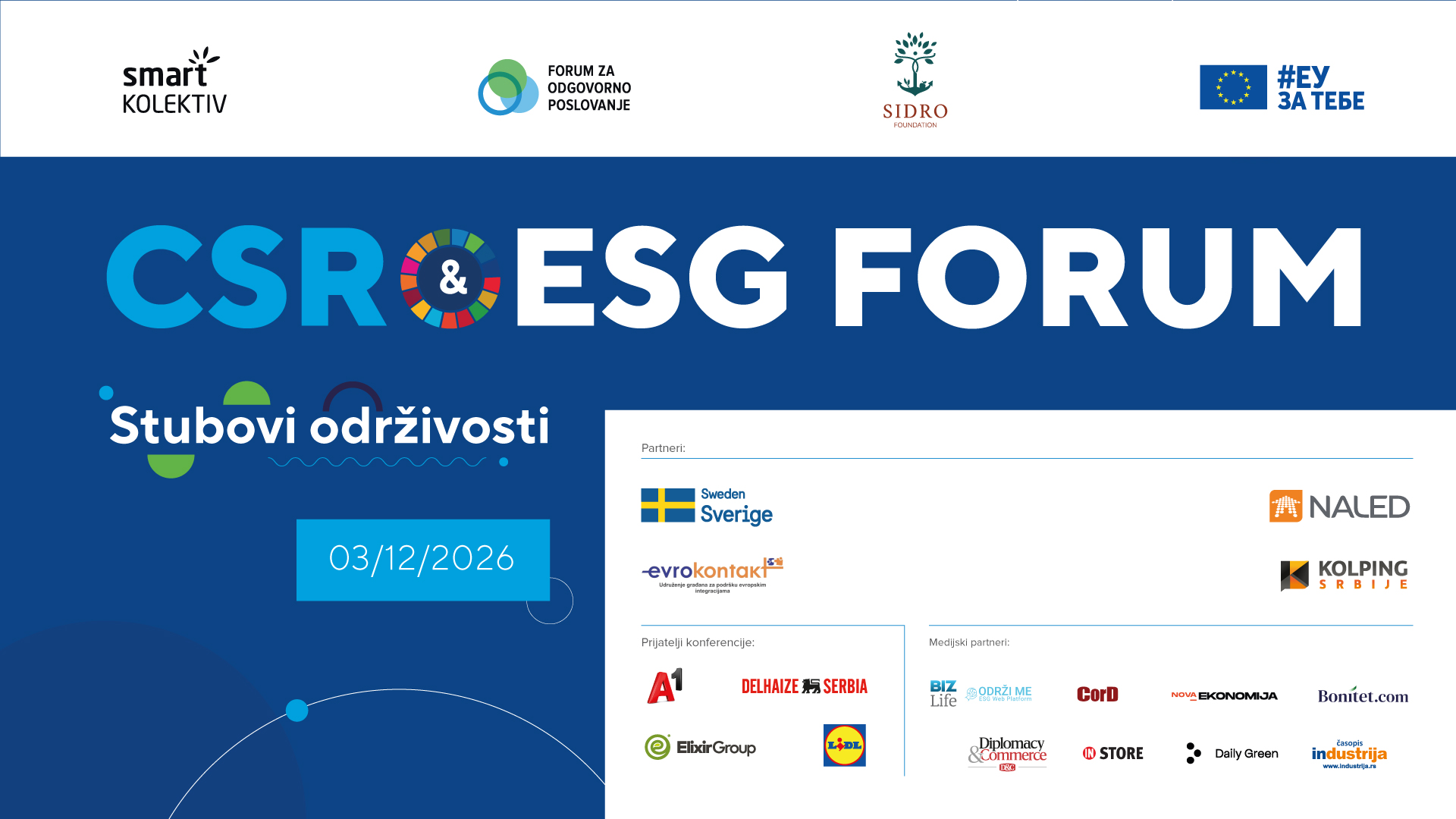
These questions will be at the heart of the CSR&ESG Forum on 3 December, which will explore four key pillars of sustainability, bringing together perspectives and experience from the business, public and civil society sectors.
PILLAR 1: CAPITAL AND IMPACT
The main panel, “From Investment to Impact: How Capital, Public Policies and Partnerships Build a Sustainable Economy”, will focus on the role of different sources of capital, public policies and cross-sector collaboration in creating the conditions for sustainable solutions and measurable social impact. The discussion will feature Neven Marinović, Director of Smart kolektiv and Executive Director of the Responsible Business Forum, who will also lead the panel discussion, alongside Jelena Savanović, Manager at the Sidro Foundation; Violeta Jovanović, Executive Director of NALED; Tijana Koprivica, Director of Sustainable Business at Delta Holding; and a representative of the European Union Delegation to Serbia.
PILLAR 2: BUSINESS AND RESPONSIBILITY
The session “Business and the Responsible Business Forum: Joint Action, Shared Priorities and Responsibility” will explore how companies can pool their experience and capacities, define shared priorities and strengthen responsible business practices through collective action. The discussion will be moderated by Milica Babić, Lead Communications, CSR and Sustainability Consultant at OTP Bank Serbia, with perspectives shared by Margareta Musić of Elixir Group, Marija Mitrović Bošković of A1 Serbia, Stefan Bićanin of Delhaize Serbia and Aleksandra Mirić of Lidl Serbia.
PILLAR 3: PARTNERSHIPS AND COMMUNITIES
The session “From Partnership to Impact: How Small Businesses, Companies and Civil Society Can Work Together to Drive Change” will showcase different examples of collaboration and explore opportunities for connecting stakeholders whose knowledge, resources and experience contribute to community development. The discussion will be moderated by Svetlana Damnjanović, ESG expert, and will feature Tatjana Dražilović of Centar Zvezda (TRANSFORMATOR alumna), Marko Rakić of HELVETAS Swiss Intercooperation, Lazar Stefanović of the Mental Disability Rights Initiative of Serbia (MDRI-S), and Vladimir Ilić of Wood Play.
PILLAR 4: KNOWLEDGE AND PEOPLE
The session “Empowered for the Future: How Education Transforms Communities”, organised by UniCredit Bank Serbia, will explore the role of education in empowering individuals and communities to shape the future. The programme will also feature participants of Sustainability Starter 2026, who will present solutions to social challenges developed through teamwork.
The Forum will conclude with the CSR&ESG Forum 2026 Awards, recognising companies and their practices in responsible business and sustainability.
The CSR&ESG Forum is organised by Smart kolektiv and the Responsible Business Forum as part of the project “Resilient Communities: Nurturing Social Enterprises for Local Development”, implemented by Smart kolektiv in partnership with Evrokontakt Kruševac and Kolping Society of Serbia, with the financial support of the European Union.
This year’s Forum is also supported by the Sidro Foundation. In addition it is supported by the project “Enhancing competitiveness through more effective public procurement and sustainable supply chains (ESGs)”, funded by Sweden and implemented by NALED.
Conference friends are A1, Delez, Elixir Group and Lidl. Media partners are BizLife, Održi me, CORD, Nova ekonomija, Bonitet, Diplomacy & Commerce, IN Store, Daily Green and Industrija.
The content of this text does not necessarily reflect the views of the European Union.