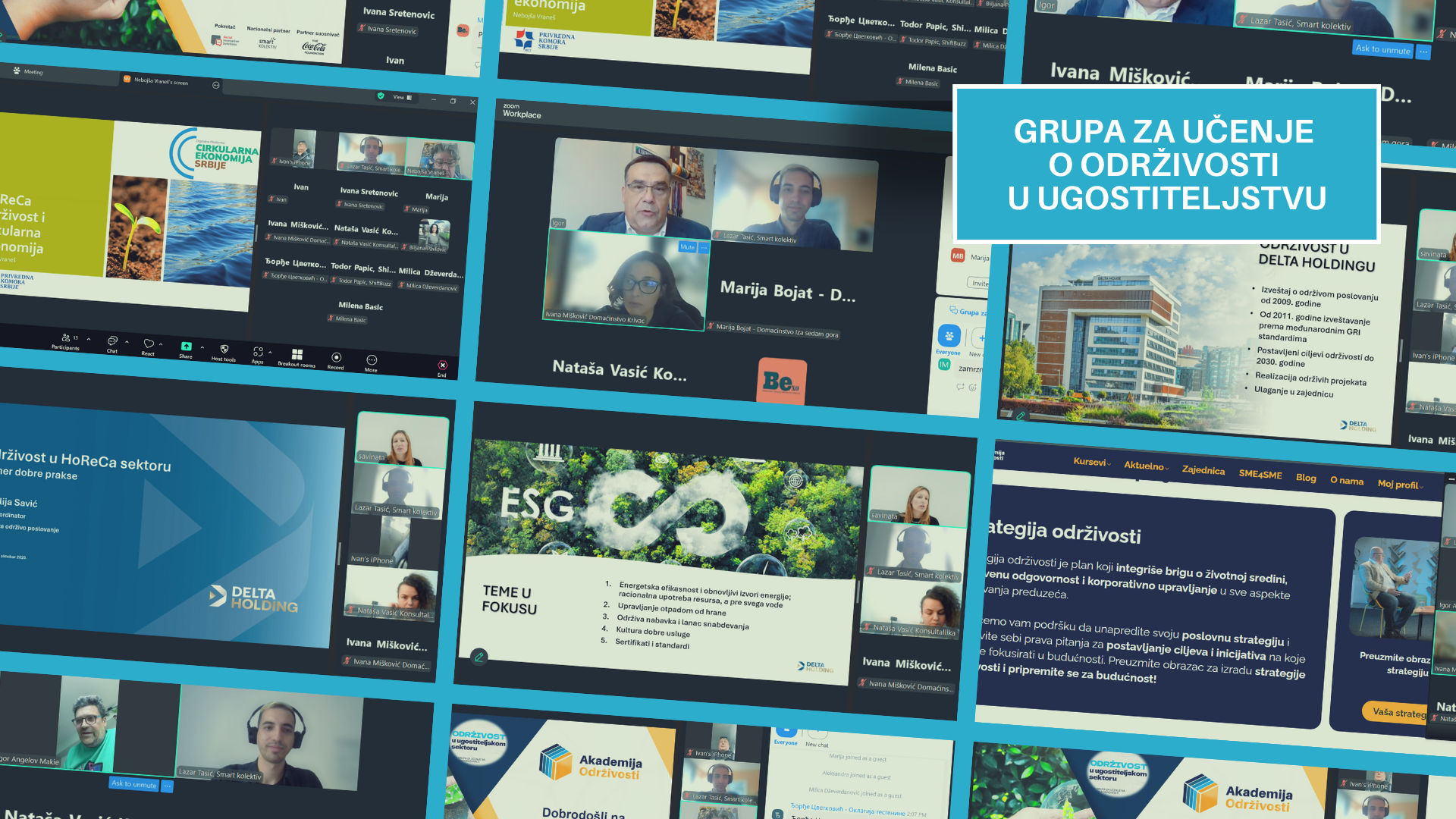
Participants of the Sustainability in Hospitality Cohort successfully completed the three-week program (October 8–29), during which they explored the key aspects of applying sustainable principles in hospitality. Directly from industry experts, participants received practical advice, examples of best practices, and guidance for developing their own sustainability strategies. The program included four webinars led by sector specialists, giving participants the opportunity to ask questions and receive concrete recommendations relevant to their businesses.
The first webinar of the cohort, Sustainability in the HoReCa Sector, was led by Nebojša Vraneš, an international expert in waste management and independent advisor on circular economy at the Chamber of Commerce of Serbia. Participants received guidance on implementing sustainable business practices in restaurants, cafés, and hotels, with a particular focus on efficient waste management.
The next webinar was delivered by Igor Ratković, General Manager of Višnjica Restaurant, who discussed integrating local suppliers into the supply chain, energy sustainability in hospitality, and the impacts of financial sustainability and profitability on business operations. He shared numerous examples from his extensive hospitality experience, emphasizing a holistic approach to sustainable hospitality.
Natalija Savić, CSR Coordinator in the Sustainable Business Sector of Delta Holding, introduced participants to sustainable practices actively implemented by the company, such as rational resource use, solar energy, rainwater collection, and CO₂ emission reduction. She also addressed the global issue of food waste and shared Delta Holding’s approach, which includes the FIFO (First In First Out) method, continuous staff and guest education, and collaboration with the Food Bank.
The final webinar featured Igor Angelov, owner and head chef of Vegangelov Restaurant, who presented the philosophy of his restaurant – healthy, tasty, and high-quality, with strong commitment to environmental care. He discussed sustainable and healthy food as a key factor for restaurant success and demonstrated through concrete examples how sustainability can be integrated into daily operations. He also shared his approach to creating menus that respect ecological and nutritional balance principles.
The cohort was an additional activity of the course Sustainability in the HoReCa Sector, which is free, available online, and can still be taken independently by all interested participants. The course is designed for restaurant, café, and hotel owners and managers, as well as other hospitality operators, who want to improve efficiency, attract new guests and investors, while contributing to their community and environmental protection.